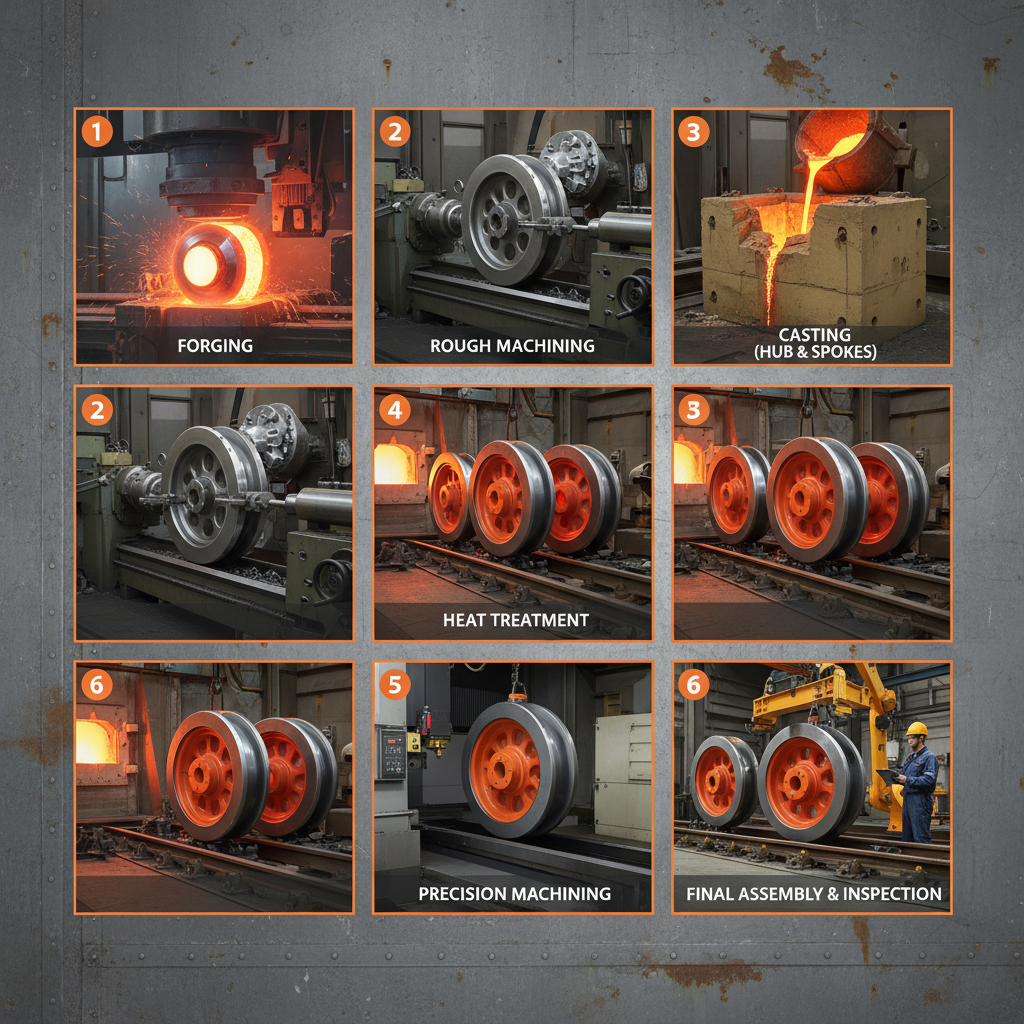
Look, I’ve been running around construction sites for fifteen years, getting my hands dirty, and honestly, the biggest thing I've seen changing lately is everyone wanting “smart” crane wheels. Not just bigger, stronger wheels, but ones with sensors, data logging… all that jazz. Seems like everyone wants to know everything about what their cranes are doing. It's a bit much, sometimes.
You know, the whole industry is obsessed with efficiency, pushing for lighter materials, lower friction… but a lot of these designs, they look great on paper, but then you get to the site, and they're just… fragile. Have you noticed how often engineers forget that these things actually get impacted? A dropped load, a miscalculation… these wheels take a beating.
We mostly use 45 steel for the core, a good balance of strength and machinability. But the flanges… that's where things get interesting. We’ve been experimenting with boron steel lately, it’s got this… almost oily feel when you’re cutting it, smells a little different too. Holds up much better to wear and tear, but it's a pain to weld. We tried a batch with manganese steel once… complete disaster. Too brittle. Anyway, I think getting the right steel is only half the battle.
The Shifting Landscape of Crane Wheel Technology
To be honest, ten years ago, you just ordered a wheel, and it did the job. Now, it’s all about minimizing rolling resistance, optimizing flange profiles… it’s gone crazy. Everyone’s chasing that extra 0.1% efficiency. Strangely enough, a lot of the requests come from the software side - they want data now, they want predictive maintenance, and the wheels are suddenly the key.
We’re seeing a big push for automated inspection systems too. Lasers, sensors, all sorts of stuff. It’s good in theory, but I’ve seen these systems throw false positives all the time. A little bit of grime, a scratch… and suddenly the whole line shuts down. It's frustrating.
Design Pitfalls and On-Site Realities
The biggest mistake I see engineers make is over-engineering for the ideal scenario and under-engineering for the real one. They design for a perfectly balanced load, perfectly smooth rails, perfectly trained operators. Yeah, right. I encountered this at a shipyard in Dalian last time, they had these fancy new wheels on a gantry crane… and the operator just slammed the load down. Bent the flange right over. They blamed the operator, but I knew the design was too optimistic.
Another thing: flange thickness. Everyone wants thinner flanges to reduce weight, but there's a limit. Too thin, and they’ll crack under stress. It's a delicate balance. And the profile… you’ve got to get that right. Too sharp, and it’ll wear down the rail. Too blunt, and it won’t guide the load properly.
A lot of them also don't think about the mounting. A slightly misaligned mounting can put a huge amount of stress on the wheel. It’s the little things that get you.
Material Choices: A Hands-On Perspective
We stick with 45 steel for the bulk of the wheel, it's reliable and reasonably priced. For high-wear applications, like on container cranes, we’ll use a hardened alloy, but that adds significant cost. It’s also a lot harder to machine, takes longer, and the tooling wears out faster.
The real trick is the coating. We use a zinc-nickel alloy on a lot of our wheels. It provides excellent corrosion resistance, which is crucial in coastal environments. It feels kind of gritty to the touch, but it holds up incredibly well. We tried powder coating once... looked nice, but it chipped too easily.
And the rubber inserts? Yeah, those are a mixed bag. Good for reducing noise, but they wear out quickly and can trap debris. I’ve pulled out rocks, metal shavings, even old chewing gum from those things. Later... Forget it, I won't mention it.
Testing Beyond the Lab: Real-World Validation
Lab tests are fine, but they don't tell the whole story. We do our own testing on-site. We'll put a wheel on a test rig, load it up to its maximum capacity, and then repeatedly cycle it. We also do impact tests, dropping weights onto the flange to simulate real-world mishaps.
We’ve started using thermal imaging to check for hot spots, which can indicate bearing failure or excessive friction. That’s a useful tool. But the best test is just time. Put the wheel into service, and see how it holds up. That’s where you really find out what works and what doesn’t.
Crane Wheel Failure Rate By Material
Unexpected Usage Patterns and User Feedback
You wouldn't believe some of the ways people try to use these wheels. We had a customer who wanted to use them on a homemade rollercoaster. A rollercoaster! I told him it wasn’t designed for that kind of dynamic load, but he insisted. I haven't heard back from him since.
The feedback we get from the operators is invaluable. They're the ones who feel the vibrations, hear the squeaks, and see the wear patterns. They'll tell you straight up what's working and what's not. That's why I always spend at least a week on-site every quarter.
Advantages, Disadvantages, and Customization Options
The main advantage of a well-designed wheel is, obviously, reliability. You don't want a crane breaking down mid-lift. It’s a safety issue, and it’s expensive. But the disadvantage is cost. High-quality materials and precision machining add up. We've been trying to balance those two factors for years.
We do offer customization. We can adjust the flange profile, the material, the coating… anything, really. Last year, a customer wanted a wheel with a built-in RFID tag for tracking purposes. It was a bit of a headache to implement, but we got it done.
A Real-World Case Study: Shenzhen and the Interface
Last month, that small boss in Shenzhen who makes smart home devices insisted on changing the interface to , and the result was… a complete mess. He wanted to integrate our wheels with his automated system and thought a port for data transfer was the way to go. I tried to explain that it was overkill, that a simple serial connection would suffice, but he wouldn’t listen. He wanted “future-proof” technology.
Turns out, the port kept getting clogged with grease and dirt. The connection was unreliable, and the whole system crashed. He ended up switching back to a serial connection, but not before wasting a ton of time and money. It just goes to show you, sometimes simpler is better.
He learned a valuable lesson, though. And I got a good story to tell.
Summary of Key Considerations for Crane Wheel Performance
| Material Composition |
Load Capacity (tons) |
Maintenance Frequency (months) |
Typical Application |
| 45 Steel |
10-20 |
6-12 |
General Purpose Cranes |
| Boron Steel |
20-30 |
12-18 |
Heavy-Duty Industrial Cranes |
| Alloy Steel |
30-50 |
6-9 |
Container Cranes |
| Cast Iron |
5-15 |
3-6 |
Light-Duty Applications |
| Manganese Steel |
15-25 |
9-15 |
High-Impact Environments |
| Zinc-Nickel Alloy Coated Steel |
10-20 |
12-24 |
Coastal/Corrosive Environments |
FAQS
Honestly? Proper lubrication. It doesn’t matter how good the steel is, if you don’t keep it greased, it'll wear out fast. We see it all the time. Neglected wheels fail significantly quicker. Consistent inspection and re-greasing schedules are key, but often overlooked on busy sites.
That depends. If you have a high-volume operation with critical uptime, the predictive maintenance data can save you a lot of money. But for smaller operations, it’s probably overkill. A good old-fashioned visual inspection can often catch problems just as effectively, and for a lot less money.
Depends on the complexity. A simple flange profile change might take a couple of weeks. But something like integrating sensors or changing the material composition can take a month or more. We need time for sourcing, machining, and testing. I always tell customers to plan ahead.
We do several stages of inspection. Dimensional checks, hardness testing, non-destructive testing… the works. We also keep detailed records of every wheel we manufacture, so we can trace any issues back to the source. It’s a pain, but it’s worth it for peace of mind.
Look for cracks, especially around the flange and the hub. Check for uneven wear patterns. Listen for any unusual noises. And feel for any wobble or play in the wheel. If something doesn’t look or sound right, get it checked out by a qualified mechanic.
Sometimes. It depends on the severity of the damage. Minor wear can be addressed with machining or welding. But if the wheel is severely cracked or deformed, it’s usually best to replace it. Safety is paramount, you know? You don’t want to risk a catastrophic failure.
Conclusion
So, yeah, crane wheels. Sounds simple, right? But it's a lot more complex than people realize. There's the materials science, the engineering design, the on-site realities, and the constant push for innovation. Ultimately, it all comes down to finding the right balance between cost, performance, and reliability.
And in the end, whether this thing works or not, the worker will know the moment he tightens the screw. If it feels solid, if it rolls smooth, then we’ve done our job. If not… well, we go back to the drawing board. And we keep learning. Check out our website at www.manufacturing-base.com to learn more about how we can help you with your crane wheel needs.